Showing posts with label Concept Car. Show all posts

Saturday, January 30, 2010

Suzuki X-Head Concept Car at the Tokyo Auto Show

Suzuki X-Head Concept Car at the Tokyo Auto Show

Suzuki X-HEAD concept: cross-utility functionality and fun

The Kamino-cloner car we showed you earlier is one of a few Suzuki concepts we'll be seeing first-hand later this month at the Tokyo Auto Show. A second concept car to see the sheets drop from atop it is the Suzuki X-HEAD concept car. its' like a mix between a Hummer, an El Camino and umm — a Tonka truck? We're at a loss for words here — but we're loving it. Full press release below the jump in all of its ESL glory and here is the high-res shot of the concept car/truck/SUV/El Camino. X-HEAD "X-HEAD" is " the cross utility vehicle " of the new genre which brings the various values which until recently are not. It has high running the whole distance characteristic, the "gym knee", "the escudo", it has high loading characteristic, DNA "of [kiyarii]" was succeeded, functional hopefulness was had. The naming, "X-HEAD" adjusting to the life style and sense of value of the person who rides, has meant the possibility this car which corresponds to various uses becoming unknown. Being possible to combine the carrier unit which is adjusted to life style 2 adults sleeps and can stay " the camper " and in the town coolly to ride it handles, " fashion " and so on, the person who rides " you play and stimulate heart and curiosity ". In addition, supposed the rescue rescue in various road circumstances " rescue " and so on, it is possible to answer also social mission, being tough, you propose the pleasant car.

Monday, January 25, 2010

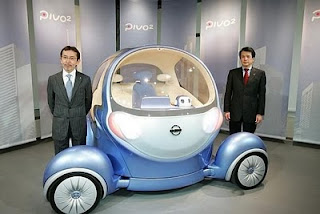
Nissan Pivo 2 electric concept car picture gallery

Tokyo, Japan — One of the many concept cars being readied for the Tokyo Motor Show in Japan is this iPod-inspired vehicle. With a design that's best described as odd and/or bulbous, it features accelerator and brake pedals embossed withaudio player symbols: fast-forward and stop. According to Nissan, the Pivo 2 is an advanced electric concept car that builds on the popularity of the first Pivo, which was shown at the 2005 Tokyo Motor Show. Power comes from environmentally friendly compact lithium-ion batteries. More of an entertaining way of transport than a traditional car, it even features a "highly innovative Robotic Agent". Drivers will never be lonely again, as the robotic companion can converse in both Japanese and English dialects, and was created to make journeys less stressful. The robotic agent is also instrumental in operating the cars functions, from heating and cooling to navigation. The entire front end of the car opens up via a large door to allow the driver and his two passengers access, and because it features a rotating cabin (the entire cabin can swivel 360 degrees) there is no need for a reverse gear. The vehicle is made even more nimble thanks to four wheels. Each of the four wheels are powered by advanced electric in-wheel '3D Motors', which can then swivel 90 degrees allowing the Pivo 2 to drive sideways as well as forward.

Sunday, January 24, 2010

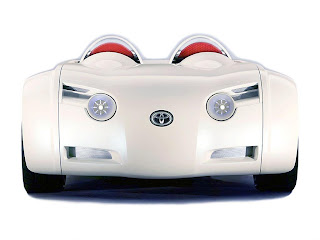
Toyota radical Compact Sports and Specially Concept Car


Toyota's radical Compact Sports & Specialty Concept Car
Toyota's radical Compact Sports & Specialty Concept Car on Body


This design car toyotas radical compact sports and specialty looks simple car modern for future. i think this concept car toyota is very futuristic car. A radical Toyota sports car featuring a hybrid petrol-electric drive-train and a host of innovative interior features was one of the stars of the media day at the 2005 Melbourne International Motor Show. The CS&S (Compact Sports & Specialty) concept was designed to demonstrate the sporting potential of Toyota's Hybrid Synergy Drive technology, as featured in the second-generation Prius production car. With its midship-mounted next-generation Toyota Hybrid System THS II based on the Hybrid Synergy Drive concept and an E-Four (electric 4-wheel drive) system, the CS&S is designed to provide outstanding environmental performance and driving exhilaration.

In the CS&S a mid-mounted 1.5 litre petrol engine drives the rear wheels while the 50kW high-output motor electric motor drives the front wheels. The arrangement gives the CS&S the extra traction of four wheel drive combined with vigorous acceleration thanks to the high torque characteristics of the electric motor. Four-wheel control provided by the E-Four system and the midship positioning of the hybrid power plant further enhance handling and road-holding performance. Toyota says the CS&S will accelerate to 100 km/h in 8.6 seconds. Despite the quick performance, the concept car's Hybrid Synergy Drive uses less fuel and has lower exhaust emissions than an equivalent conventionally-engined sports car.

The CS&S's innovations extend to the interior which features a revolutionary human-machine interface called Toyota Space Touch (TST). The TST system uses a series of holographic projections which the driver "touches" to control functions such as air conditioning, audio, satellite navigation and email. The car's seating system is flexible, allowing the CS&S to be converted from a two-seater to a 2+2 by the removal of canopies behind the two front seats. In addition, the front passenger seat has been designed in such a way that it can be rotated to cover the entire cockpit area like a hard tonneau cover, thereby boosting anti-theft security


Saturday, January 23, 2010

Wiesmann GT Concept Car


This Car Wiesmann GT a design concept car for future because this car looks modern and luxury car. The success of the Roadster concept is based on a successful synthesis of classic design and state-of-the-art engineering. This encouraged Friedhelm and Martin Wiesmann to develop a new, similarly fascinating, sports car on the basis of the Roadster, the Wiesmann GT. The two-seater coupé celebrated its premiere as a production vehicle at the IAA 2005 in Frankfurt, to be acclaimed by the motoring experts.

Despite the suggestions of a classic design as a further development of the Wiesmann-Roadster it was a completely new car which was created. Basic data were gained from the Wiesmann Racing GT, which was tested as a experimental vehicle under extreme conditions during the 24-hour race at the Nürburgring in 2002. Since it was clear from the outset that this vehicle would not only be optically different, but based on different fundamental data, from the Roadster, there was plenty of room for manoeuvre in the development. Starting point for considerations was the engine. This was to represent a new sparkle, come what might.

Since, as it is well known, displacement can only be replaced by one thing, and that is more displacement, thoughts quickly made friends with the idea of using a BMW V8 engine of 4.8 litres capacity. This made a larger engine compartment than the Roadster's essential, which consequently meant that all the dimensions of the Wiesmann GT would have to be oriented towards that. Thus, the GT grew in all directions, compared with the Roadster: it was three centimetres higher, eleven wider, and no less than 37 longer. To take account of the rather higher fuel consumption of the larger engine, 10 litres additional fuel tank volume was provided, at 70 litres, to guarantee adequate range on longer journeys.

The challenge now facing the engineers was to convert the engine's output into vehicle dynamics. Normally, a larger vehicle also weighs more, which in turn adversely affects the performance figures. This was avoided by designing an aluminium monocoque, familiar from the racing scene. In this way, the increase in weight was kept within bounds, and at 70 kg was extremely modest for a car of this size. The bodywork is of lightweight, high-quality, fibreglass-reinforced compound material and in the familiar manner is also fabricated in the factory. The xenon headlights ensure good visibility in darkness, and the rear lights, which consist of LEDs, not only give a clear signal but are also unmistakable as the hallmark of the Wiesmann GT even at night.

With a power-to-weight ratio of 3.41 kg/HP the Wiesmann GT is to be found in the leading group of sports cars. The low centre of gravity, the perfectly-tuned running gear combined with the bullish torque delivered by the engine, the optimum seating position for driver and passenger ensure unalloyed driving enjoyment. The Wiesmann GT is an individual sports car with a classic design, which fits perfectly in the automotive landscape and which will capture its own niche.

Monday, January 18, 2010

Concept Car 2006 Porsche 911 Turbo 997 with TechArt Tuning

Concept Car 2006 Porsche 911 Turbo 997 with TechArt TuningCool Design Car Porsche 911 Turbo 997 with TechArt Tuning

World Debut at the ESSEN-MOTOR-SHOW 2006. Porsche 911 Turbo 997 with TechArt Tuning review:TechArt Tuning for the new Porsche 911 Turbo 580 hp / 427 kW, 0 / 100 km/h in 3.46 Seconds, 339 km/h V/max. Maximum performance paired with optimized aerodynamics: TechArt Automobildesign turns the new Porsche 911 Turbo into one of the world’s fastest and most powerful street-legal sports cars. 580 hp / 427 kW, 0 / 100 km/h in 3.46 seconds only and a maximum speed of 339 km/h are the most important performance figures of this car.Concept Car 2006 Porsche 911 Turbo 997 with TechArt TuningBeautiful Design Car Porsche 911 Turbo 997 with TechArt Tuning

The TechArt VarioPlus coil-over suspension is available for the electronically adjustable PASM damper system of the new Turbo. This chassis offers not only an individually adjustable ride height by up to 25 millimeters, but also selectable ‘Normal’ and ‘Sport’ damper settings at the push of a button on the dashboard. However, the settings are not limited to these presets. Both settings automatically firm up their damper rates during sporty driving. The result is an optimal symbiosis of excellent ride comfort during leisurely driving and agile, highly responsive handling during fast cornering. As a world-renowned specialist for exclusive interior creations TechArt Automobil design also offers individual interiors for the latest 911 top-of-the-line version in all colors and designs. The 580 hp / 427 kW Turbo was upgraded with an exclusive TechArt CarboBlack leather trim, white cockpit panels matching the car’s outside color and further sporty accessories. They include an ergonomically shaped airbag sport steering wheel, foot pedals, foot rest and shift knob all made from aluminum as well as stainless-steel sill plates with TechArt logo.

Concept Car 2006 Porsche 911 Turbo 997 with TechArt TuningPorsche 911 Turbo 997 with TechArt Tuning in beside

The 3.6 liter boxer engine was modified by TechArt in many details. Two bigger turbochargers contribute to the TechArt engine tuning just as the sports air filter and the stainless steel exhaust system with special manifolds and integrated high performance catalysts. All modifications get exactly tuned by the recalibrated ECU. After the conversion the engine delivers 580 hp / 427 kW at 6,000 rpm and a maximum torque of 700 Nm at 4,850 rpm. Power transmission to all four wheels is made via a modified six-speed manual gearbox with TechArt gearshift travel shortage and additional gearbox-oil cooling. Of course the TechArt engine conversion is also available for cars with Tiptronic transmission. The coupe tuned by TechArt is one of the world’s fastest super sports cars: The two-seater coupe catapults from 0 – 100 km/h in 3.46 seconds. Maximum speed is 339 km/h.

Concept Car 2006 Porsche 911 Turbo 997 with TechArt TuningCool Design Car Porsche 911 Turbo 997 with TechArt Tuning with beside

Water cooled six-cylinder boxer twin-turbo engine with TechArt performance tuning consisting of 2 special turbochargers with variable turbine geometry, sports air filter, TechArt stainless steel high performance exhaust system with special manifolds and steel-bed high performance catalysts and a recalibrated ECU. TechArt engine design package. Displacement 3,600 cm
Bore x stroke 100 x 76.4 mm
Max. power 580 hp / 427 kW at 6,000 rpm
Max. torque 700 Nm at 4,850 rpm (from 3,200 / 6,000 rpm permanently more than 670 Nm)
Compression-ratio 9.0:1
Max. boost 1.2 bar
Max. revs 7,100 rpm
Power output per liter 161.11 hp per liter capacity Permanent four-wheel drive
Six-speed manual gearbox with modified transmission-ratios in 5th and 6th speed, TechArt gearshift travel shortage and additional gearbox-oil cooling Gear ratios:
1st speed 3.82
2nd speed 2.14
3rd speed 1.48
4th speed 1.18
5th speed 0.92
6th speed 0.75 Axle ratio 3.44 TechArt VarioPlus coil-over sport suspension TechArt Formula light alloy wheels, one-piece, 8.5Jx20 in front with 245/30 R 20 ContiSportContact3 tires, 12Jx20 in rear with 325/25 R 20 tires. Standard Porsche Ceramic Composite Brake
Front: 380 mm discs and 6-pot aluminum Monobloc fixed calipers
Rear: 350 mm discs and 4-pot aluminum Monobloc fixed calipers Bodywork:
2+2 seater coupe with TechArt body styling kit I, consisting of: front spoiler I, side skirts, side mirror moldings, rear spoiler I, roof spoiler, rear diffuser, headlight moldings
Length 4,450 mm
Width 1,852 mm
Height 1,300 mm
Wheel-base 2,350 mm
Tank capacity 67 liters
Curb weight 1,592 kg
Weight/power ratio 2.74 kg / hp Performances:
Acceleration: 0/100 km/h: 3.46 s
Maximum speed: 339 km/h Retail price: about 200,000 Euros
End of Porsche 911 Turbo 997 with TechArt Tuning review.

Concept Car 2006 Porsche 911 Turbo 997 with TechArt TuningPorsche 911 Turbo 997 with TechArt Tuning on Back Body

These performance figures make greatest demands on perfectly balanced aerodynamics. The TechArt designers developed bodywork components in the wind tunnel which don’t only give the 911 Turbo its distinctive look but especially optimal aerodynamic downforce and a drag coefficient reduced by 4 percent. The TechArt front spoiler reduces aerodynamic lift by 15 percent. They also moulded a new wing profile for the retractable production rear spoiler which produces 20 percent extra downforce in conjunction with the TechArt rear diffuser. The understated TechArt roof spoiler visually stretches the roofline. The TechArt side sills give the 911 top-of-the-line model a longer, sleeker look. The side mirrors can be attractively upgraded using the TechArt mirror moldings. The look is rounded out with moldings for the headlights. Especially for the new Porsche 911 Turbo they developed the striking TechArt Formula five-spoke wheels in size 8.5Jx20 in front and in size 12Jx20 on the rear axle. TechArt recommends ContiSportContact 3 tires in sizes 245/30 ZR 20 and 325/25 ZR 20 for mounting on these wheels.